

“It’s the economy stupid.” – 1992
In 1650 the archbishop of Armagh, James Ussher, began studying the Old Testament as well as ancient Egyptian and Hebrew texts with an eye towards calculating the day of Creation. He came up with one fine Sunday evening on October 23rd, 4004 BC. Others would nit-pick it a bit and say that technically the effort began bright and early first thing the next morning, and none other than Sir Issac Newton was reported to have a take, saying Creation was six years later in 3998 BC. In 1859 Charles Darwin published The Origin of Species, and in 1953 Caltech chemist Clair Patterson dated the age of the Earth as 4.55 billion years plus or minus 50 million years. So, there you have it, a couple different views on the origins of the Earth and the low entropy life forms that inhabit her. Either way you view it a tremendous amount of energy was involved in order to drive the high entropy environment of the time down to the low entropy Earth, flora and fauna that we enjoy today.

Low Entropy Fauna | Spotted Walking the Dog, Keeping a Sharp Eye on Us | Source: Thermocon
This tremendous amount of energy required to create the Earth and the life forms aboard her is not just any old kind of energy. It was and is energy with a purpose. Energy with a purpose is created by primary energy being forced through a thermodynamic cycle by Mother Nature or man, to yield dispatchable megawatt hours at a time and location of our choosing out the other side. Furthermore, and crucially when it comes to understanding the root of the problem is that this portion of the energy game is amenable to theoretical analysis from first principles. Also required is a machine, whether manufactured by Mother Nature or man, to carry out this energy conversion and this portion of the energy game is not amenable to theoretical analysis from first principles.
We stepped through some of the amenable theoretical analysis in our first piece, Pants, where we profiled a theoretical steam turbine with a furnace burning methane, effectively pushing said methane through the Steam Rankine Cycle. We arrived at a theoretical HHV thermal efficiency of 36.5% extracting 1,016 MW from our imaginary steam turbine with the pump requiring 16 MW on the front end to arrive at a net 1,000 MW (1 GW) power plant.
In our second piece, Friends, we stepped through a theoretical gas turbine analysis, again burning methane and pushing said methane through the Brayton Cycle. We arrived at a theoretical thermal efficiency of 37.2% extracting 1,774 MW from our imaginary gas turbine with the compressor on the front end chewing up 774 MW leaving a net 1,000 MW (1 GW) power plant. One thing that jumps out at the astute reader – the pump absolutely saves the Steam Rankine Cycle. That also brings to mind what we’ll call Thermocon’s Three Laws of Operational Uptime:
Law 1 – Rotating Equipment is the bane of your existence
Law 2 – If you have to…use a Pump
Law 3 – If you really…really…have to then use a Compressor
There is a theoretical limit to just how high the efficiency of these heat engines can be as posited by French engineer Sadi Carnot in 1824. Yale physicist Josiah Williard Gibbs would flesh out the problem in its entirety in a series of papers between 1873 – 1876 defining what came to be called the Gibbs Free Energy, and we made this the subject of our third piece, Energy’s Ladder. We had a reader provide a great comment to one of our later pieces regarding the subject of Gibbs Free Energy, and we look to pay off on this refresher below. It only took us a year to get to it, but better late than never, and we list the key part of the comment below.
Although energy and entropy are understood by a fair number of STEM educated people, Gibbs free energy is uncommonly encountered and likely needs a bit of a refresher for most of us. Your way of linking it to the economics of energy production is very clever as we struggle to compare the apples, oranges, and walnuts of energy production with a common metric. Thanks.
The Gibbs Free Energy of any fuel is its enthalpy, or heat content, minus the inherent entropic haircut of the Second Law of Thermodynamics. Physically, this represents the theoretical maximum amount of work, the maximum available force in a defined direction at a time and location of our choosing, or dispatchable megawatt hours, available in any primary energy source. The rest of any primary energy source must be dissipated as random heat and cannot be used to actually do anything. The Gibbs Free Energy concept is broader than the physics governing a heat engine alone, it covers everything; chemical reactions, wind, thunderstorms, solar panels, life on Earth, you name it, everything. It is a theoretical impediment that cannot be sidestepped and, in our view, is the most practical manifestation of the Second Law of Thermodynamics. Another key aspect of Gibbs Free Energy is that it is not conserved. Pockets of Gibbs Free Energy have collected over time and we as humans run around this planet looking for those pockets, our whole lives depend on it.
Back to our theoretical analysis, the nice thing about using methane is that it is a defined molecule with defined properties that have been measured by scientists. In the case of methane, and if we’re following things correctly, the Gibbs Free Energy available in that molecule is 91.8% of its total primary energy, the other 8.2% must go to random heat. Our theoretical steam turbine and gas turbines were only able to extract 36.5% and 37.2% respectively as work. These efficiencies may feel a little light relative to the theoretically posted number of 91.8%, but they are actually extraordinary compared to the efficiencies achievable prior to the invention of these machines.
In our fourth piece, For Whom The Wind Blows, we took a shot at estimating the thermodynamic cost of the high entropy of wind by turning to a monetary measure, as this portion of the problem is not amenable to analysis from first principles. We estimated the subsidy required by wind power as $10.65 per megawatt hour and posited that this was the amount of monetary overlay required to paper over the high entropic penalty of wind. We further posited that this was due to the fact that in order to generate power wind was forced through something called the Betz Cycle. The theoretical maximum Gibbs Free Energy available in the Betz Cycle is 59.3% of the primary energy entering the front end. This is a substantial haircut relative to methane with its 91.8% Gibbs Free Energy on the front end and a big part of the reason why power plants based on methane don’t require a subsidy and those based on wind do.
Proceeding undaunted, in our fifth piece, The Sun Also Sets, we estimated the subsidy required by solar photovoltaic panels as $33.62 per megawatt hour and posited that this was the amount of monetary overlay required to paper over the high entropic penalty of sunshine. We then posited that this increased subsidy relative to wind was due to the fact that the maximum available energy in sunlight according to the Shockley-Queisser limit is 33.2% and that this theoretical degradation of the primary energy source straight out of the gate was the source of the higher subsidy.
With all this talk of the high subsidies related to wind and solar, it was high time to add hydrocarbons to the list. We did this in our sixth piece, Sins of Our Fathers, and the number we arrived at was $0.52 per megawatt hour, a mere fraction of the others, and one that essentially rounds to zero. We posited that to the extent money is actually just an overlay for the exchange of dispatchable megawatt hours, applied energy, a force through a defined direction at a time and location of our choosing, whatever you want to call it, the hydrocarbon subsidy must by definition be zero as they power the whole thing, our whole lives depend on them.
In our seventh piece, Saving the Atmosphere (By Destroying The Earth,) we added the average price of wholesale power to the plot. In this case we arrived at $50.25 per megawatt hour wholesale power price, you read that right. Solar is being spotted thirty-four bucks and wind eleven bucks out of a total energy game of around fifty bucks. These numbers were generated by gathering subsidy data and generation data from various sources that are listed in those respective pieces. It would be nice if there were a single source of truth, so to speak, that we could run the numbers on. Turns out there is.
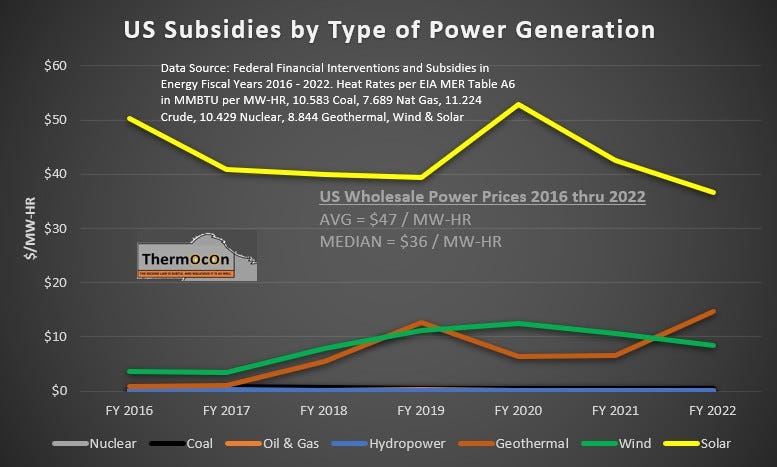
Power Generation Subsidies by Primary Energy Source | Data: EIA Federal Financial Interventions and Subsidies in Energy Fiscal Years 2016 – 2022
The EIA produced a report in 2023 titled “Federal Financial Interventions and Subsidies in Energy Fiscal Years 2016 – 2022.” All data for primary energy production and subsidies paid are included right in the report along with a reference to the heat rates used. This report was produced right in the heart of the Biden administration, so one would think the report to be about as friendly to wind and solar as possible. The outcome of our analysis is shown in the plot; the results don’t exactly match with what we previously produced, but they sure do rhyme, and they essentially round to our previous numbers by any reasonable measure.
The report does however provide us a clue to pay some attention to. The subsidies for nuclear, coal, oil & gas, and hydropower are essentially zero. The subsidy for wind is non-trivial and then as usual solar is completely beyond the pale. Nothing particularly enlightening there, however, look at what is happening with geothermal. It started out at essentially zero subsidy in 2016 but has steadily increased to a level commensurate with wind. In our zeal to pursue geothermal energy we are increasing the subsidy level to where it is no longer an energy source at all. The second law lurketh, and it hath cometh for the ideologues pursuing geothermal.
Our first seven pieces were essentially all created to lay the groundwork for and flesh out the magnitude of the inherent entropic haircuts lurking in various fuels. As previously mentioned, the first portion of this is amenable to theoretical analysis from first principles and is focused mainly on thermal efficiency, and while admirable, being to wedded to these analyses alone can lead to a boneheaded energy understanding. As an example, a lot of thermodynamic texts say fuel cells are not subject to the same entropic haircuts as heat engines, which is true. Then some of the newer texts will go on to say this means generating electricity with a fuel cell is more efficient than burning methane in a gas turbine, which is not true. Note that old thermodynamic textbooks don’t eschew nonsense like this.
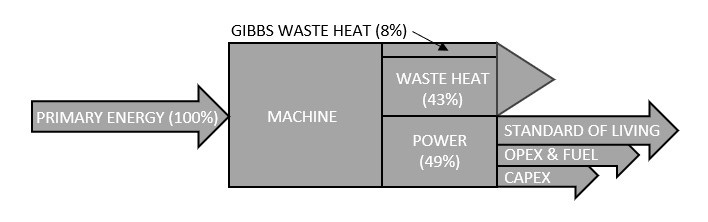
Energy Flow Through a Machine | Heat Rate 7,000 BTU/kW-hr | Source: Thermocon
There is a second aspect of the inherent entropic haircut in any fuel and that relates to the applied energy required to gather the fuel, build the machine in the first place, as well as operate and maintain the machine throughout its viable lifetime. Then what remains we can use to lower the entropy of our surroundings, also known as enjoying a higher standard of living.
This portion of the problem is not amenable to analysis from first principles; thus, the result of this analysis can quickly devolve into the desired outcome of the analyzer. It has been largely given the label of Energy Return On Energy Invested (EROEI) and a concise summary of that concept that we enjoyed reading can be found here: The Energy Cost of Energy.
As it sits, we have estimated theoretical measures of the first portion, and monetary measures of the second portion of the inherent entropic haircut in any fuel; that was the point of our first seven pieces, and as attested to earlier we figured it would all scale with Gibbs Free Energy, but that turns out not to be the case. The diffuse nature of wind and solar results in an excessive capital expenditure that essentially buries them from the git-go, particularly solar as shown above, and unfortunately geothermal is now getting in on the subsidy action.
In our eighth piece, Peak Cheap Oil Already Happened (And We Lived) we began to stray off into a series of pieces more focused on hydrocarbons, where we actually come from in the first place, but we did circle back to the subject of energy subsides in our 12th piece, Don’t Save Me Chief. There are two sources of entropy that these subsidies are papering over. The first is the inherently high entropy of the energy sources themselves that we just broke down into a thermodynamic portion and a capital expenditure portion. The second aspect of the increased entropy of wind and solar is the fact that they are intermittent.
As with the capital expenditure portion of the diffuseness issue, there is no way to calculate the thermodynamic haircut of intermittency from first principles, so once again we turned to a monetary measure. In order to estimate the entropic cost of intermittent energy we looked to Norway, where they were kind enough to allow the British and the Germans to connect to their perfectly well functioning grid in 2021 and visit all kinds of entropy upon it. All the while providing climate lecturing no doubt. We won’t reproduce the plots here, but if you want to revisit Don’t Save Me Chief, it is just blatantly obvious that everything was just fine until 2021 when the British and Germans showed up with their so-called Shangri La of wind and solar. We estimated the entropic cost of intermittency at $50 per megawatt hour.
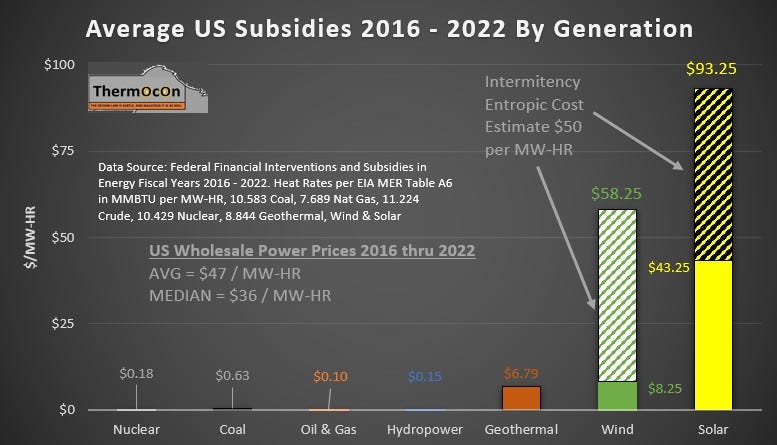
Average Power Generation Subsidies by Primary Energy Source 2016 – 2022
We’ve added that $50 per megawatt hour to the subsidy tally of wind and solar and provided an average across 2016 – 2022 also including nuclear, coal, oil & gas, and hydropower. The average subsidy of the things that actually work essentially rounds to zero. Geothermal has got in on the subsidy game now being spotted the same amount as wind pre-intermittency. The average US wholesale power price during this period was $47 per megawatt hour with the median being $36 per megawatt hour. When “firmed-up” by being connected to a grid, wind and particularly solar are not energy sources at all, they are purely parasitic.
We had a reader provide a great comment to our estimate of the effective subsidy provided by grid connection to wind and solar, and upon reflection we tend to agree that our estimate may be a little light. It is most certainly penetration dependent, and when taken to its logical conclusion, the intermittency cost of a 100% wind and solar grid may in fact be infinite. A portion of the comment is below.
That is the reason why the retail rate for power in California with its huge quantity of high-entropy solar and wind generation is typically the highest in the continental U.S. We think your estimate for absorbing the increase in entropy is low because the electricity price in California is about double the national average.
If we’re understanding things correctly, the Gibbs Free Energy available in sunlight is 86.8% of the primary energy coming in. It has been measured by scientists. Why then is photovoltaic solar power so utterly horrible from a thermoeconomics perspective? Turns out it’s the entropy stupid. Full disclosure, we had eyeballed the folly of wind and solar a long time ago and thought, well it’s the Gibbs Free Energy, and that turns out not to be the case, it’s broader than that. The Gibbs Free Energy doesn’t account for the increased capex, opex or intermittency.
From a second law perspective, how the energy game works is as follows. Find a source of low entropy energy and force it to a high entropy. As a reward for doing this, one can then force the high entropy of their surroundings to a low entropy minus a humungous haircut. This haircut consists of the thermodynamic cycle chosen, the thermodynamic cost of the fuel and the machine and any thermodynamic cost to provide said energy at a time and location of relevance.
A solar panel is a very low entropy device. It is highly ordered. Sunshine is very diffuse; its entropy is very high. So high in fact that sunshine captured by a solar photovoltaic panel cannot provide the energy to manufacture itself. It can’t produce any net dispatchable power. To add insult to injury the only thing worse than a solar panel is a solar panel with battery backup. The sunshine can’t make the panel in the first place, how’s it going to make the battery; another highly ordered low entropy device.
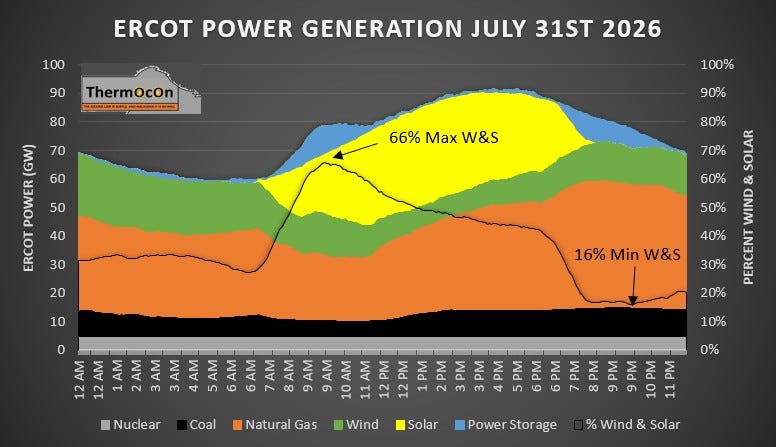
ERCOT Grid Power Sources July 31ST 2026 | Source: ERCOT
As an illustration, we provide a plot of the energy sources on the ERCOT grid for July 31ST 2026. This is going to be hard for some readers to stomach, but the energy from solar panels shown on this plot is not from sunshine. It is from the coal that was used to manufacture the panel in the first place. However, the high-quality low entropy energy in that coal has undergone some sort of crapification process where the high entropy of sunlight has been allowed to infiltrate it. The same is true of wind, only to a lesser extent. Energy from wind turbines is definitively superior to that from solar panels, but still insufficient to power a modern society. A sane summary of the above plot is as follows; except for the nuclear, it is ALL carbon.
We fear that the ERCOT grid is headed for a blackout. These percentages of wind and solar are too high. Texas has an incredible energy bounty and thus has many low entropy sources that can beat back the forces of all this entropy, but there is a limit, and we fear they may be approaching it. Plus, the sheer lunacy of it all – imagine all the thermal cycling these wonderful, low entropy, methane burning gas turbines have to endure to carry all this virtue signaling nonsense forced upon the grid by the intelligentsia.
At the risk of rolling it Don Quixote, we can’t believe more people are not seeing this. Solar panels are not energy addition; they are energy subtraction. They provide less than zero. Wind turbines and solar panels have no place on a modern electric grid; the entropy of sunshine is too high. The effects of this high entropy are beginning to permeate through society in ways that are hard to comprehend due to the subtleness of the second law, beginning with the poor and now increasingly hurting the middle class; and wealthy people are being fooled into financing it. Not so fooled that they quit flying private of course, let’s not get crazy here. When people wake up to the realities of energy this is going to go down in human history as one of the greatest departures from sound science of all time. There may be hell to pay. We hope not but we are a little surprised that it has gone this far.
“♡ Like” this piece to celebrate low entropy. – TC
Thank you for your recent articles and the roadmap showing the inter-relationships between your articles. You make the case for the most economical and reliable grids being powered by dispatchable low-entropy energy sources. (You have not touched the power engineering construct of grid frequency stability requiring adequate synchronous grid inertia [SGI] to prevent blackouts. Solar, wind, and batteries are further disadvantaged by contributing neglibible SGI. See: https://greennuke.substack.com/p/why-is-grid-inertia-important That's why I call their power, "Junk Power.") I appreciate your inclusion of my quote regarding the economic penalty of the high-entropy California power grid.
Brilliant and so simple. I am not in the league of the author or other commenters as I didn't do maths or science at school (a funny story not relevant here) but in my arguments to friends down here in Australia - where our standard of living is diminishing at a great rate, where we have a socialist government who are subsidizing Chinese-made (by coal) solar and wind turbines across vast swathes of our landscape yet ban nuclear (our uranium deposits are the worlds biggest and we're about the export it to India), and are closing coal fired plants, blocking gas and oil development but producing volumes of hot air and CO2 from their ivory tower in Canberra - I have long asked the inconvenient question: where did the energy come from to make your solar panels, your turbines, your Chinese EVs and their batteries not to mention your tv, refrigeration, computer, your steel trusses to build your shelter and their batteries glass and steel architectural icons in which your government department HQs reside, etc.? They tell me I'm stupid because I didn't go to university and don't know how to argue properly. I usually say something like 'whatever... who wants a short black, or a cappuccino' as I clear the table.
I'm now going to find all your other articles Thermocon. Great work.